
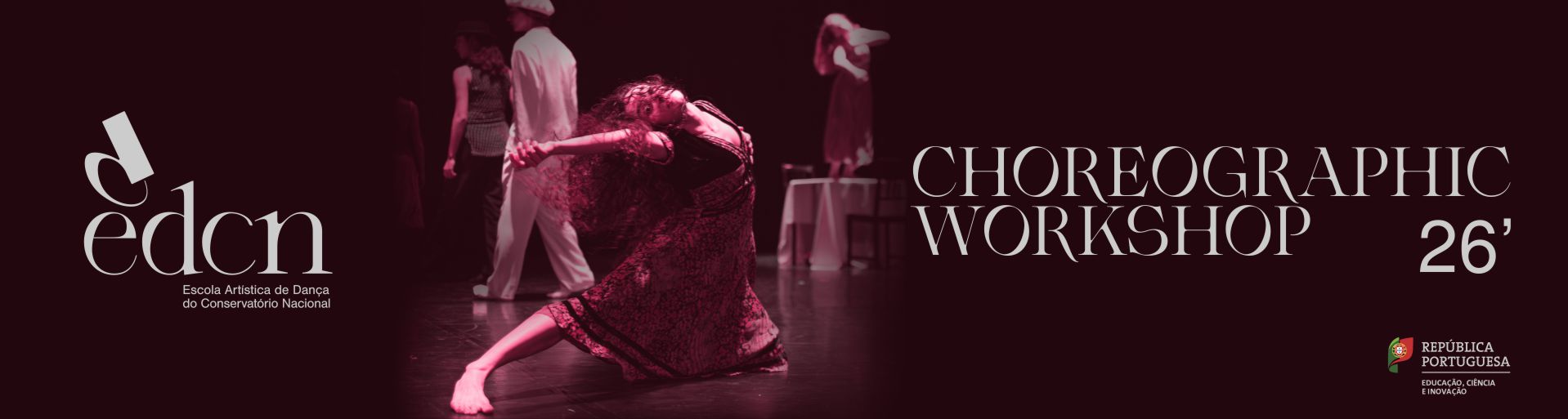
“Within the context of the breadth of technical and artistic education, the Choreographic Workshops present themselves as a space for creative enjoyment, with the constant objective of artistically promoting students, both in terms of technical, interpretative and creative demands.”
Paulo Ferreira
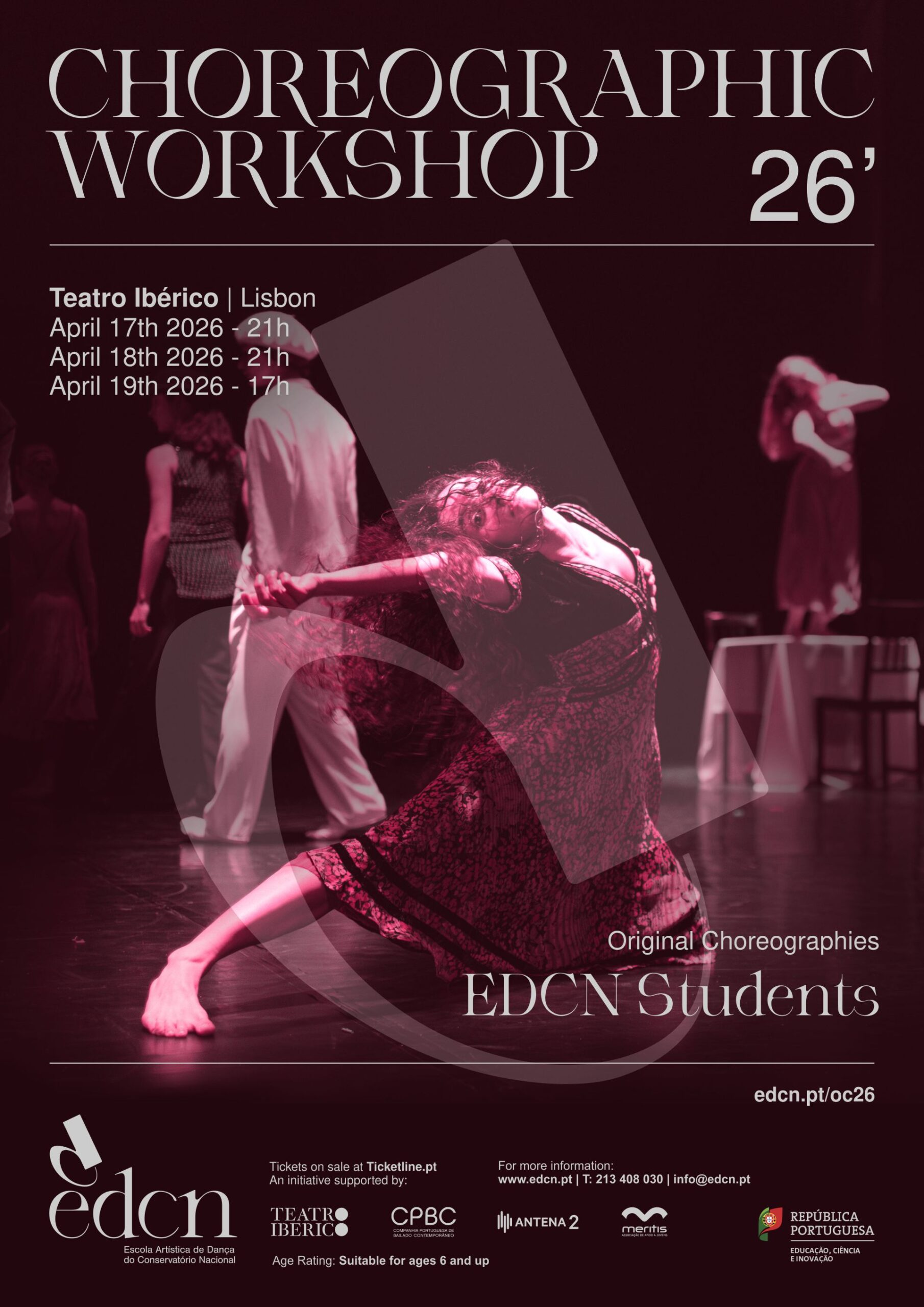
Teatro Ibérico – Lisbon
Presentations:
April 17th 2026 – 21h | april 18th 2026 – 21h | april 19th 2026 – 17h
Duration: 1h40 | Show suitable for ages 6 and up
Original Choreographies EDCN Students
Tickets on sale at www.ticketline.pt
An initiative supported by:

PROGRAM
OC 26′ – I Part
01
Outra vez arroz
Coreography
Rafaela Ferreira
Interpretation
Aurélio Bizzarri | Beatriz Giménez | Diogo Medeiros | Leonor Santos | Lucas Rodrigues | Tiago Pais
Synopsis
We wake up. We produce. We fulfill. We repeat.
We move before we think. We repeat before we choose.
The days follow one another in a hypnotic rhythm, as fluid as it is unchallenged. Automatism slowly settles in with the smoothness of everything we never dared to refuse. And, little by little, we inhabit a comfortable place where we do things without questioning, where we live without truly being. But what if, in the midst of this routine trance, we decide to stop? What if we finally choose to live instead of just continuing? Once again, Arroz is a journey about the comfort of habit and the (audacious, but necessary) risk of interrupting it to truly find life.
Music
Barbatuques | Christophe Zurfluh | The Alchemist | Travis Lake
Lights
Ricardo Campos | Rafaela Ferreira
Costumes
EDCN
Duration
3’46’’
— —
02
De Pé, Juntos
Coreography
Beatriz Sousa
Interpretation
Afonso Minderico | Inês Faria | Rita Pinto
Synopsis
Many communities marked by a lack of resources and opportunities learn very early on that survival is a collective effort. When the system fails, it is the people who support each other. This piece stems from the reality of economically disadvantaged cultures and populations who find purpose in unity. It is not a romanticized view of poverty, but rather a recognition that in sharing, faith, cultural roots, and mutual support, a concrete form of happiness is born.
Music
Christopher Tin
Lights
Ricardo Campos
Costumes
EDCN
Duration
3’20’’
– –
03
Memórias do que serei
Coreography
Leonor Santos
Interpretation
Henrique Palma | Rúben Santos
Synopsis
Inspired by the figure of Janus, the two-faced Roman god who simultaneously looks to the past and the future, this work explores the duality of time, identity, and transformation. The duet marks the meeting point of a being that once was and that is yet to come. Each step towards the future carries the weight of the past, of a journey made not in a straight line, but in a succession of failures, typical of the human being who stumbles and loses breath, but who uses this impulse to create a new and unexpected movement of constant recovery and adaptation. The strength that results from the differences in time and the rhythmic accidents of life. An arrhythmia that breaks the idealized normality, allowing growth and individuality. The moment when the body ceases to be a machine and becomes an organism that reacts, fails, and reinvents itself to continue living.
Music
Marek Hunhap | Modeselektor | Thom Yorke
Lights
Ricardo Campos | Leonor Santos
Costumes
EDCN
Duration
2’33’’
– –
04
Lá ao fundo à esquerda
Coreography
Diogo Medeiros
Interpretation
Afonso Minderico | Inês Faria | Leonor Santos | Lucas Rodrigues | Maria Eduarda Miranda | Rafaela Ferreira
Synopsis
It could be “just over here,” “the second one on the right,” or even “where the street ends.” That’s not the case, because “over there on the left” is where my path doesn’t end. And, faced with the infinite forked choices that “over there on the left” suggests, I have the opportunity to choose to go that way or any other branch. He told me, slowly and respectfully: – Dance is a process made of choices. I chose to listen to him. I realized that each and every movement is a decision that builds the dancer I am. It is in these decisive movements that dance ceases to be just dance – it becomes a metaphor for life itself. On stage, six personalities convinced of choosing the path that seems right to them, surrounded by indecision, stimuli, desires, and passions. Six ways of understanding right and wrong, decision and manipulation. And three conversational conversations, which lead to the individual and collective certainty of the individuality of choices, challenging the audience to choose which one to follow. Likewise, the audience chooses and becomes part of this creation of decisions and non-decisions. In the end, there is no right or wrong path. There is only the one that is taken. Every gesture is a decision. And every decision is who we choose to be. Just turn left at the far end.
Music
Poema “Cântico Negro” de José Régio (interpretado por João Villaret) | John Adams | Max Richter
Lights
Ricardo Campos | Diogo Medeiros
Costumes
EDCN
Duration
5’00’’
– –
05
Maybe, just maybe.
Coreography
Inês Baptista
Interpretation
Inês Baptista
Synopsis
The piece reveals the vulnerability of not having immediate answers, but also the strength that comes from accepting the unknown. Perhaps it is precisely in uncertainty that the courage to continue is born.
“Maybe, just maybe.” delves into the delicate space between uncertainty and possibility. Through movement, the body becomes a place of questioning, where contradictory emotions coexist and transform.
Music
Marit Bergman
Lights
Ricardo Campos | Inês Baptista
Costumes
EDCN
Duration
3’00’’
– –
06
voarOstar
Coreography
Afonso Minderico | Ana Lima
Interpretation
Ana Lopes | Aurelio Bizzarri | Beatriz Sousa | Catarina Teles | Diogo Medeiros | Inês Faria | Lara Ribeiro | Tiago Pais
Synopsis
‘voarOstar’ stems from a profound anguish: the decision to make between two ways of life. On one side, a simple, carefree, and mundane existence; on the other, a path of constant change, risk, and overcoming, which demands ambition and courage to always want more. Throughout the work, this choice ceases to be a distant hypothesis and begins to approach, becoming inevitable. As the moment of decision approaches, uncertainty sets in. Thoughts fragment, overlap, clash, until the mind becomes a battlefield between the security of the known and the appeal of the unknown. This piece reflects our anxieties as young people who are forced to choose a life without ever having truly lived it. It speaks of the weight of expectations, the pressure of the future, and the restlessness of deciding who to be before knowing who one is. Between the simple and the complex, between staying and risking, the work exposes the vulnerability of growing up – and the inevitability of choosing.
Music
Afonso Minderico
Lights
Ricardo Campos | Afonso Minderico | Ana Lima
Costumes
EDCN
Duration
5’00’’
— —
07
Entredentes
Coreography
Stefanos Patrinos
Interpretation
Stefanos Patrinos
Synopsis
“Entredentes” explores the conflict between intention and expression, focusing on a word that, although repressed due to its nature, yearns to be spoken aloud. Initially pronounced in a muffled and repressed way, almost hidden, this word gains symbolic awareness throughout the narrative, transforming into an entity that fights for its own affirmation. The solo unfolds as an internal journey of tension and resistance, where the word, deprived of control over its freedom, still tries to conquer space, clarity, and dignity. Between the impulse to silence and the desire for liberation, an invisible but profoundly human battle is built.
“The greatest truths are spoken through gritted teeth.”
Music
TSVI
Lights
Ricardo Campos | Stefanos Patrinos
Costumes
EDCN
Duration
2’24’’
– –
08
Reunião de Condomínio
Coreography
Beatriz Giménez
Interpretation
Ana Lima | Aurélio Bizarri | Diogo Medeiros | Henrique Palma | Lucas Rodrigues | Madalena Pereira | Rafaela Ferreira | Rita Pinto
Synopsis
“Reunião de Condomínio” delves into the absurd routine of a community that gathers to decide what is right and wrong. Amidst broken voices, impatient breaths, and accusatory glances, the meeting transforms into a ping-pong of blame and hypocrisy: each accusation returns to the one who made it, each forgotten rule is pointed out to the neighbor. A choreography about how we judge in others what we do every day, and how, together, we laugh, criticize, and hide behind our own morality.
Music
Franz Schubert
Lights
Ricardo Campos | Beatriz Gimenez
Costumes
EDCN
Duration
3’37’’
— —
09
FOMO
Coreography
Joana Valente Guerreiro
Interpretation
Joana Valente Guerreiro
Synopsis
FOMO-Fear Of Missing Out
A body in constant alert, hesitating between impulse and paralysis. The fear of not arriving, of not being, of being left behind. An anxiety that throbs in isolation, trembling before the feeling of always being one step behind, running against something that never slows down.
Music
Chorus | Ryoji Ikeda
Lights
Ricardo Campos | Joana Valente Guerreiro
Costumes
EDCN
Duration
2’15’’
– –
10
inSOMNUS
Coreography
Rita Pinto
Interpretation
Aurélio Bizzarri | Henrique Palma | Lucas Rodrigues | Manuel Salgado | Leonor Santos | Rafaela Ferreira | Rúben dos Santos
Synopsis
Sleep paralysis (paralysis + somnus) is a transient phenomenon characterized by the temporary inability to move the body when falling asleep or waking up, although the person remains conscious. It occurs due to the persistence of muscle atonia typical of REM sleep while the brain is already in a waking state, and may be accompanied by vivid hallucinations and a feeling of pressure in the chest. It can occur in isolation or associated with sleep disorders, such as narcolepsy, and is generally considered benign and related to factors such as sleep deprivation and stress.
Music
AGF | Graig Armstrong | Raffertie | Robert Ruth
Lights
Ricardo Campos
Costumes
EDCN
Duration
4’07’’
OC 26′ – II Part
11
Frigus Internum
Coreography
Lucas Rodrigues
Interpretation
Rafaela Ferreira | Tomás Rodrigues
Synopsis
An immobilized body survives in the cold, in suspension, and in denial. A voice, present as an inevitable force, breaks this state and imposes awakening. Currently, there is much talk about “embracing who we are,” but this aria reminds us that becoming conscious can hurt. The body resists change, breaks down, tries to return to the silence that protected it. Movement arises without relief and without promise: only as a consequence of having been awakened. There is no liberation, only the impossibility of going back.
Music
Henry Purcell | Interpretação: Alexandre Matta | Vicente Pinheiro (Viola) | Alice Pitta (Violoncelo) | Martim Pereira (Violino I) | Luísa Sobral (Violino II) | Tomás Rodrigues (Barítono)
Lights
Ricardo Campos | Lucas Rodrigues
Costumes
EDCN | CPBC
Duration
2’50’’
– –
12
“ ‘tou Só A Ver”
Coreography
Tiago Pais
Interpretation
Afonso Minderico | Beatriz Giménez | Henrique Palma
Synopsis
From the outset, the individual finds themselves in a state of constant surveillance, where “just seeing” means being controlled. In an environment of continuous exposure, every gesture is observed, interpreted, and judged, creating a silent but persistent pressure on whoever exists in that space. “‘I’m Just Seeing” reveals the responses to this control: the anger that emerges from the invasion, the pride that manifests as affirmation, the defense of a camouflaged narcissism, and the indifference that arises as a state of emotional autonomy and detachment. Between observation, confrontation, and resistance, different states are traversed, reaching a common point among them.
Music
lain Armstrong | Luciano Berio
Lights
Ricardo Campos
Costumes
EDCN
Duration
3’45’’
– –
13
Frize
Coreography
Manuel Salgado
Interpretation
Diogo Medeiros | Aurelio Bizzarri
Synopsis
Two bodies cross paths as if they already knew each other before they existed. There is a raw, almost inevitable attraction that brings them closer—but also a silent inability to remain. Each gesture is laden with meaning, each absence weighs more than it should. It is not a lack of feeling; it is an excess.
This relationship is not merely represented—it is constructed before the eyes of the viewer, like a book being presented to us. They explore what they are to each other with the tools they have: aggressive gestures, dense silences, contradictory impulses. They try to understand the strength, the weight, and the depth of what they feel, even when it overwhelms them.
Between approaches and ruptures, they experiment with ways of being: they say too much, or they say nothing. Because, so often, we don’t know how to deal with what we feel—and we choose paths that distance us, even when everything in us wants to stay. Throughout the play, they transform themselves. They try, they fail, they learn, they change. There are no definitive answers, only the continuous movement of two bodies seeking — in each other and in themselves — a possible way to exist together without losing each other. Because sometimes it’s not love that fails. It’s that we still don’t know how to inhabit it..
Music
Agnes Obel
Lights
Ricardo Campos | Manuel Salgado
Costumes
EDCN
Duration
2’30’’
– –
14
Em stock
Coreography
Ariana Fechet | Rúben Santos
Interpretation
Henrique Palma | Lucas Chambel | Lucas Rodrigues | Manuel Salgado | Tiago Pais
Synopsis
Masculinity appears as an ancient code, repeated automatically. Strength as obligation, silence as defense, dominance as proof of existence, vulnerability as failure.
But when the promise of purpose is removed, everything begins to falter. Maybe the game was never about winning.
Maybe it’s just about what we do when we realize that nobody is keeping score.
Music
Aloboi | Jay Ragsdale | Yair Elazar Glotman | Woodkid
Lights
Ricardo Campos | Ariana Fechet | Rúben Santos
Costumes
EDCN
Duration
4’00’’
– –
15
Insomnia
Coreography
Penélope Ratibo Marinho
Interpretation
Penélope Ratibo Marinho
Synopsis
Insomnia explores the liminal state between physical exhaustion and the incessant activity of the mind. While the body seeks rest, thoughts intensify and prevent inner silence, prolonging a suspended time where rest is desired but never fully achieved.
Music
Travi
Lights
Ricardo Campos | Penélope Ratibo Marinho
Costumes
EDCN
Duration
1’51’’
– –
16
MNEMA, The Art of Remembering
Coreography
Lara Ribeiro | Leonor Simões | Nao Miura
Interpretation
Ana Lima | Ana Lopes | Afonso Minderico | Aurelio Bizarri | Beatriz Sousa | Catarina Teles | Diogo Medeiros | Madalena Pereira | Maria Eduarda Miranda | Leonor Santos | Momoko Fujisaki | Inês Faria | Rita Pinto | Sebastião Quintela | Henrique Palma
Synopsis
This piece explores nostalgia as a sensory and emotional experience. Through smells, colors, tastes, and small memories of everyday life, it revisits significant moments from different phases of life. Some good and light, others difficult and demanding. It questions the idea that the past is lost or erased, showing that the versions of ourselves remain present within us. Nostalgia thus emerges not only as longing, but as an awareness of the journey taken and the multiple identities we carry over time. Taking this idea, each dancer represents a type of memory.
Music
Travis Lake
Lights
Ricardo Campos | Lara Ribeiro | Leonor Simões | Nao Miura
Costumes
EDCN
Duration
5’30’’
– –
17
Chickens are a type of dinosaurs
Coreography
Henrique Palma
Interpretation
Beatriz Giménez | Lucas Rodrigues
Synopsis
“Chickens are a type of dinosaurs” delves into the instinctive genesis of childhood behavior, where discovery is not a passive act, but a mutual learning process. Starting from the assertion that chickens belong to an ancestral lineage, the work investigates the plasticity of belief and how truth is constructed and imposed through the other. From this state, pathologies inherent to growth are dissected: obsessive repetition as a learning tool, mimicry as a form of belonging, and the restlessness that pulsates in the face of novelty.
Music
Clara Rockmore | Edvard Grieg
Lights
Ricardo Campos
Costumes
EDCN
Duration
3’57’’
– –
18
Kuroi Ikari
Coreography
Lucas Chambel
Interpretation
Lucas Chambel
Synopsis
Legend has it that a young man, with his sword, develops an addiction throughout his life: killing and feeling the thrill of watching his target die. This piece portrays a chapter of that legend, where he loses the sword he loves so much and expresses anger and anguish at not having what he desires in his hands.
Music
Trevor Morris
Lights
Ricardo Campos | Lucas Chambel
Costumes
EDCN
Duration
2’20’’
– –
19
Variáveis Dependentes
Coreography
Inês Lima Faria
Interpretation
Aurélio Bizzarri | Henrique Palma | Leonor Santos | Lucas Rodrigues | Madalena Pereira
Synopsis
Dependent Variables explores the complexity of human relationships, starting from the idea that each of us is the result of a series of interactions and encounters that shape how we think and act.
These interactions shape not only our identity, but also our perception and reaction to the world. Each contact with another person activates memories, emotions, and internal patterns, making us reflect on who we are and how we relate to others.
We do not become who we are in isolation. We are relational beings: we constantly influence and are influenced. It is in this space of exchange that empathy is found, as the ability to feel and understand the other, recognizing that each presence contributes to what constitutes us.
Music
Amadeus Mozart | Ben Frost & Daníel Bjarnason
Lights
Ricardo Campos | Inês Faria
Costumes
EDCN
Duration
04’00”
– –
20
Non stop, reveal
Coreography
Bárbara Calado
Interpretation
Bárbara Calado
Synopsis
The body breaks the norms, undergoing a process of inner liberation. Between restrained movements and abrupt impulses, an identity is revealed that no longer asks permission to exist. It’s not about provoking, but about asserting oneself, without shame, without filters, without limits. It’s the refusal to shrink, and the raw affirmation of presence. A body that expands, that takes risks and occupies its space without hesitation. It is raw energy. It is freedom in motion. A loose, intense, and unstoppable body.
Music
The Prodigy
Lights
Ricardo Campos | Bárbara Calado
Costumes
EDCN
Duration
1’55’’
– –
21
War Zone
Coreography
Madalena da Silva Pereira
Interpretation
Afonso Minderico | Ana Lima | Ana Lopes | Ariana Fechet | Aurélio Bizzarri | Beatriz Giménez | Beatriz Sousa | Catarina Teles | Diogo Medeiros | Maria Eduarda Miranda | Henrique Palma | Inês Faria | Lara Ribeiro | Leonor Santos | Lucas Ribeiro | Manuel Salgado | Maria Leonor Simões | Momoko Fujisaki | Nao Miura | Rafaela Ferreira | Rita Pinto | Rúben Santos | Sebastião Quintela | Tiago Pais
Synopsis
Carried along by the relentless march of war, in the dry and repetitive rhythm of advancing bodies, under the weight of conflict, each step, each gesture, each glance carries fatigue, urgency, and tension. The violence and monotony of the battlefield reveal human fragility, physical and psychological exhaustion, and the impossibility of finding rest or escape. Between the dry and irregular clashes and the heavy dragging of exhausted bodies, emerges the intensity of the lived present, where body and mind are traversed by war, without relief.
Music
Romain Rachline Borgeaud | RB Dance Company | Rihanna | Odesza
Lights
Ricardo Campos | Madalena de Silva Pereira
Costumes
EDCN | Mariana Pereira
Duration
4’03’’
Technical Sheet OC 26′
ARTISTIC COORDINATION & COMPOSITION TEACHER
Liliana Mendonça
COURSE DIRECTION
Catarina Moreira
EXECUTIVE PRODUCER
Tatiana Guedes
STAGE MANAGEMENT
Students (6th Dance Year / 10th Academic Year) | Tatiana Guedes
TECHNICAL DIRECTION OF THE SHOW
Ricardo Campos | Sérgio Joaquim
MUSIC CURATION
Diogo Vida
SOUND
Alunos do 6º/10º ano
COMUNICATION
João Mota
TECHNICAL COORDINATOR
Francisco Vinhas
PRODUCTION SUPPORT
Alunos do 6º/10º ano | Tatiana Guedes
WARDROBE MANAGER
Ana Paula Rei
WARDROBE TEAM
Ana Paula Rei | Gracinda Lucas | Alunos do 6º/10º ano
ADMINISTRATIVE COORDINATOR
Sónia Lucas
EDCN DIRECTION
Paulo Ferreira | Pedro Mateus | Tatiana Guedes